
ByIn response to the media blackout on the situation in South Arabia
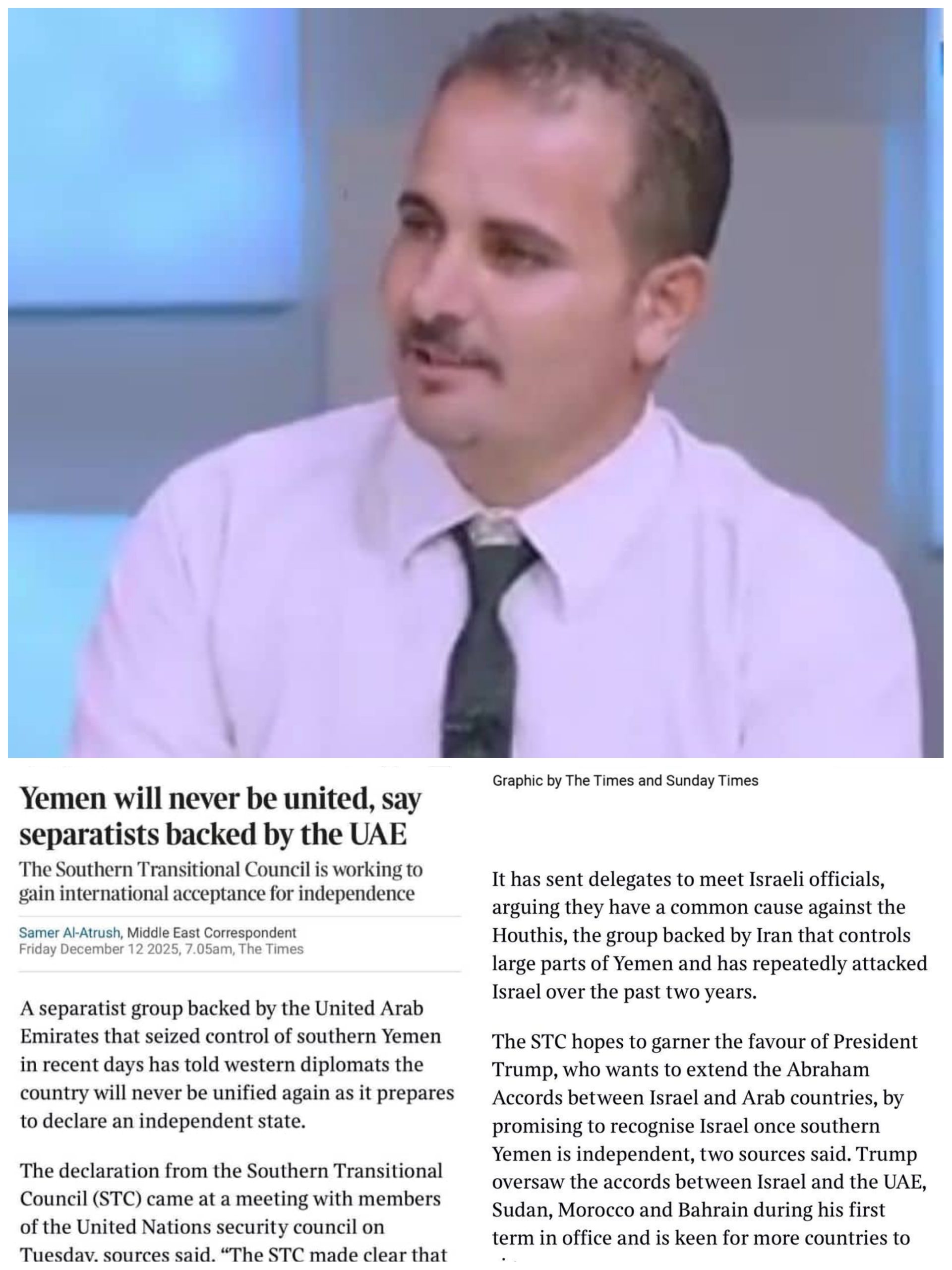
By/Abduljaleel Naji Alhumaidi
Critical Response: The Need for Accuracy and Context in Reading the South Arabian Scene*
To the Editors of the Middle East Reports Desk at (The Times / The Sunday Times) and the writer Samer Al-Atrash,
We are writing to comment on the recent report published regarding developments in South Arabia, stemming from our belief in the importance of media coverage that is based on accuracy and historical depth. We believe that the report in question, despite the importance of the platform on which it was published, relied on simplifications and ready-made descriptions that fail to reflect the complexity and reality of the political and military landscape in the South.
1. On the Simplification of “UAE-backed Separatists”*
The description “UAE-backed separatists” represents a misleading and unprofessional political simplification of a political issue with deep historical roots. This description ignores the fact that the Southern Transitional Council (STC) did not emerge from a vacuum; rather, it is based on:
A Broad Popular Base: Embodied by the peaceful Southern Movement (Al-Hirak) that began many years before regional intervention.
Political and Military Representation on the Ground: It emerged from the Southern Resistance, which confronted the Houthis and extremist groups.
The use of this description aims to dwarf a historical popular cause into a mere tool of external influence, thereby ignoring the self-determination will of the people of the South.
2. The Reality of the
Collapse of Yemeni Unity in 1990*
The report lacks the correct temporal context when addressing the issue of the “end of the 1990 unity.” The reference to the STC’s position is not an announcement of “ending a unity” that is still standing, but rather a description of a reality that has already collapsed.
1994: Unity structurally, politically, and militarily disintegrated after the 1994 summer war, where de facto authority was imposed by force on the South.
2014: Any hope for partnership was dashed with the Houthi takeover of Sana’a and the collapse of the central state.
Holding the South responsible for the “state collapse” is disregarding the historical context and structural failure that led to the dissolution of the Yemeni entity, placing the blame on the party that was subjected to invasion and displacement.
3. Linking the Southern Project with the Normalization Issue*
The link drawn between the South Arabian project and the Israeli issue through indirect accusations or “alleged contacts” is an uncontrolled political leap that lacks objective evidence.
The Southern Transitional Council has not issued any official declaration or political document adopting a normalization project.
This link serves cheap media sensationalism rather than objective understanding of the nature of the conflict in the region, and it distracts from the declared political goals of the South.
4. The Complexity of the Saudi Position*
Portraying Saudi Arabia as an “opposing” party to the independence of the South is an oversimplification of the complex reality of the relationship.
The Kingdom deals with a new geopolitical and security reality on the ground.
Riyadh’s position is governed by regional security calculations and the interest of stability on its southern borders, not necessarily an ideological unitarian stance.
The relationship is one of partnership in counter-terrorism and halting Iranian expansion, and it is more nuanced than a simple “opposition” description.
5. The Significance of Geographical and Historical Terminology*
The use of the term “Southern Yemen” instead of “South Arabia” is a neglect of the serious discussion about the political and historical identity of the South as a distinct entity that gained its independence from Britain under the name People’s Democratic Republic of Yemen (before the unity).
Returning to pre-2015/2014 terminology ignores the radical shifts on the ground and reproduces old descriptions that are no longer relevant to the new political reality.
In conclusion, we urge the newspaper to adopt a systematic review in its coverage of Southern affairs, avoiding simplification and providing the reader with an analysis based on historical context and actual popular representation on the ground, rather than ready-made functional descriptions.
Sincerely,